

On 9 September 2026 the European Commission published its proposal for a Public Procurement Act - a single Regulation to replace the three 2014 directives that every Irish and EU tender you bid on runs under. It covers public contracts, utilities and concessions in one rulebook, and because it is a Regulation rather than a directive, it will apply directly in every member state, with no national transposition in between.
Before anything else, two facts that set your expectations. This is a proposal: it now goes to the European Parliament and the Council, and proposals change on the way through. And its application is deferred by two years after adoption, so you will be bidding under the current rules for a good while yet.
One more fact for calibration. The 2014 reform also promised simpler procedures and better SME access, and the European Court of Auditors spent a decade measuring the result: competition fell, single bidding nearly doubled, and the reform had no demonstrable effect on either. The Commission's own evaluation of the 2014 rules concedes their objectives were only partially achieved. So the right way to read this proposal is the way we read a bid: give credit for what is concretely there, and hold the applause until it survives contact with reality.
Here is what is concretely there.
What changes for the bidder - and the test each change has to pass
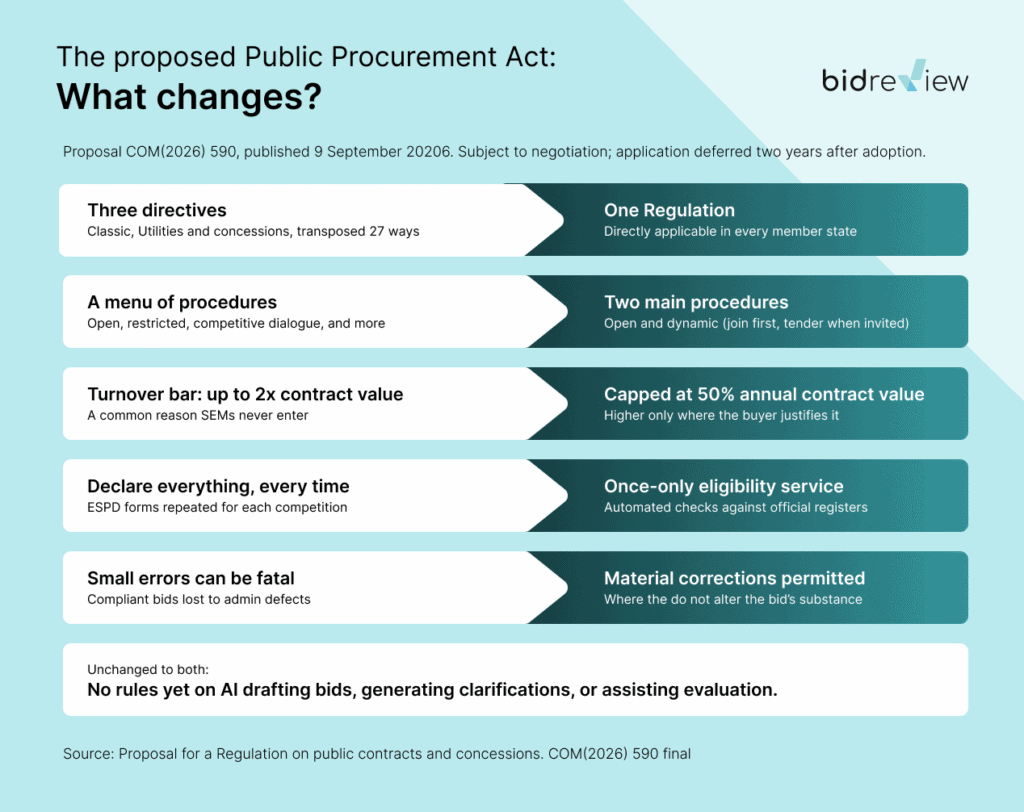
Two procedures instead of a menu. The proposal collapses the current set of procedures into two main routes: an open procedure, where you tender from the outset, and a new dynamic procedure, where you join a supplier base first and are invited to tender or negotiate for individual contracts as they arise. Both can run with or without selection criteria, and with or without negotiation. Less time decoding which procedure a buyer is running is a real saving for a small bid team. The test: flexibility for buyers can also mean variety for bidders - two procedures with four configurations each is still eight things to learn. Watch how buyers actually use the options.
Mistakes stop being automatically fatal. The proposal permits material corrections in tenders where they do not alter the substance of the bid. We score finished bids for a living, and administrative defects a correction would have cured are a regular reason compliant bids die - why bids lose marks often has little to do with the offer itself. If this survives negotiation intact, it is worth real money to small bidders. The test is the word "material": how generously buyers and courts read it will decide whether this is a safety net or a technicality.
Turnover requirements get capped. Minimum turnover requirements may not exceed 50% of the estimated annual contract value, except where the buyer justifies more. The current rules allow up to twice the contract value, and thresholds set high have quietly kept SMEs out of work they could deliver. A cap the buyer must justify exceeding is a better rule than a ceiling nobody polices. The test sits in the words "duly justified cases" - exceptions have a way of becoming templates.
Demands for public-sector track record get restricted. Unjustified requirements for prior public-sector experience - the barrier that keeps new entrants permanently new - are curtailed, and selection criteria generally are limited to what is necessary and proportionate. That principle exists today and is unevenly honoured; writing it more sharply into a directly applicable Regulation gives a challenger something firmer to point at.
Prove your eligibility once. An electronic eligibility service becomes the principal means of showing you are not excluded and that you meet selection criteria, built on the once-only principle, with automated verification against criminal, tax and social-security registers. Anyone who has completed the same ESPD declarations for the fortieth time will see the point. The test is delivery: this needs member states to connect national registers, and the proposal itself phases the digital ecosystem in over years. Treat it as direction of travel, not a promise for next quarter.
Consortia and subcontracting get easier. The proposal explicitly facilitates groups of economic operators and preserves contractual freedom in subcontracting, naming SME access as the reason. Useful, and consistent with how small firms actually win larger contracts - together.
How it compares to Ireland's own Strategy
Ireland published its National Public Procurement Strategy 2026-2030 five weeks before this proposal, and the two documents share a diagnosis: SME access too low, competition too thin, data too poor, buyer capability stretched. The differences are worth an SME's attention.
The Act is law where the Strategy is intent. The Strategy commits to guidance, information notes, working groups and reviews. The Act, if adopted, applies directly: a turnover cap is a rule a bidder can quote back to a buyer, not an action with a named owner and a date. Where the two eventually differ, the Regulation wins.
On data, the Act mandates what the Strategy promises. The Strategy is honest that incomplete award data erodes trust and commits to publishing more. The Act requires every member state to establish a National Public Procurement Data Space feeding a Union-level one, with expanded publication obligations across the contract lifecycle. For bidders, better data means better decisions about what to chase - if the quality problem the Strategy admits to is fixed rather than reproduced at scale.
On people, the Act adds the word the Strategy is missing. The Strategy's capability pillar is about skills and training. The Act requires member states to support professionalisation and to ensure the relevant actors have the capacity to apply the framework - capacity meaning staffing and resources, not just courses. Bidders feel the difference between a trained buyer and a resourced buying function every time a clarification goes unanswered for a week.
And both share the same blind spot. Neither document governs what AI is already doing inside the tendering transaction - drafting bids, generating clarification questions, and starting to assist on the buyer's side of the table.
The AI gap that survives the rewrite
The proposal automates the machinery of procurement. Eligibility checks become automated verifications the buyer must use. In the dynamic procedure, a buyer faced with more than five interested operators may shortlist by random algorithmic selection. Documentation is to be automated to the extent possible. Data flows into national and Union platforms by obligation.
On AI in the transaction itself, the proposal is close to silent: no disclosure rules, no rules on AI-assisted evaluation, nothing on what a buyer must record when a tool helps score your submission.
That gap matters to you for a practical reason. Every simplification above lowers the cost of entering a competition, and drafting tools have already lowered the cost of writing one. Our register data shows the result: clarification volumes multiplying in document-heavy sectors, and submissions converging on the same fluent, compliant shape. In a field like that, evaluators separate bids on the one thing tools cannot generate: specific, verifiable evidence - a named contract, a dated outcome, a figure someone can check. The proposed rules make the race cheaper to enter. They do not change what wins it.
Some Irish buyers are already ahead of the rulebook. One university, asked in a published clarification register whether using AI would be penalised, answered that it would not - but that the authority expects generated information to be checked and verified. That is the sensible position, and bidders should assume it spreads: use the tools, and stand over every claim they produce.
The takeaway
For SME bidders the proposal is genuinely promising: capped turnover thresholds, restricted experience demands, correctable errors, eligibility proved once, two procedures instead of a maze. The scepticism is earned, not reflexive: the last rewrite made similar promises and measurably failed to deliver, this one still has a negotiation and a two-year deferral ahead of it, and its hardest tests hide in soft words like "material" and "duly justified". Bid under today's rules. Prepare for a market that is cheaper to enter and more crowded once you are in - where the bids that win are built on evidence an evaluator can score. That is true under the 2014 directives. It will be just as true under the Act.
Know how your bid scores before the buyer does. BidReview audits finished tenders against the buyer's own criteria, before you submit. Run the free scorecard at bidreview.ai.