
Tender News & Insights
Latest news & insights from the world of tendering in UK & Ireland.

Measuring and Improving Your Bid-to-Win Ratio
Win rate is only one tender metric. Learn which bid KPIs to track and how pre-submission scoring can help improve your bid-to-win ratio.

The EU Public Procurement Act: What It Means for Your Next Bid
What the proposed EU Public Procurement Act means for Irish SMEs, including tender procedures, turnover caps, eligibility, AI and bid scoring.

The Limits of Reviewing Your Own Bid
Your bid team knows too much about its own proposal. Learn why familiarity hides scoring gaps and why detached review improves tender quality.

A Pre-Submission Tender Checklist for SMEs
SME reviewing a pre-submission tender checklist before uploading a bid

Tendering in Ireland: The Experience vs the Data
The European Court of Auditors measured competition across EU procurement over a decade. Here is what the data tells us.

How Lean Bid Teams Compete Against Large Proposal Functions
How can a small bid team compete with a large one? Large organisations have obvious advantages in tendering. They may have: dedicated bid managers proposal writers...

AI That Writes Your Bid vs AI That Checks It
Should you use AI to write your tender? Generative AI has changed bid writing. A model can take a tender question and produce a fluent answer in seconds. That sounds...

How Evaluators Actually Score Quality Responses
Understand how procurement evaluators score quality responses, what causes deductions and how specific evidence makes higher marks easier to award.
BidReview.ai shortlisted for the National Procurement Awards 2026
We’re delighted to announce that BidReview.ai has been shortlisted for the National Procurement Awards 2026, in the Procurement Technology Provider category.

Adding a Scoring Step Between Writing and Submitting
A pre-submission scoring pass tests your tender against the evaluator’s rubric before submission. Learn how to build one into your bid workflow.

Five tender errors that cost marks before you submit
Five common tender mistakes that cost bidders marks before submission — and the checks that can catch them before an evaluator does.

What the Procurement Act 2023 Changed About Tender Scoring
Understand how the Procurement Act 2023 changed tender scoring in the UK, what MAT means, and how UK procurement differs from Ireland and the EU.

Human Review vs AI Review of Your Bid: What Each Catches (And Misses)
Consultancy bid reviews and AI bid audits catch different things. Cost, turnaround, consistency and blind spots compared – and when to use which.

AI Tender Questions Are Changing Too: What Buyer Clarifications Reveal
Clarification questions on Irish tenders changed character in 2026 – and buyers hardened in response. What the data means for your clarification strategy.

Should You Disclose AI Use in a Tender? (And What Buyers Are Asking)
AI-use questions are appearing in tender documents. Why honest disclosure is the safe answer, what a good clause looks like, and how to respond.

The Generic Ceiling: Why AI-Written Answers Cluster Mid-Band
AI-drafted tender answers cluster mid-band: complete, fluent, evidence-empty. A worked pair shows what breaks the ceiling – and why prose never does.
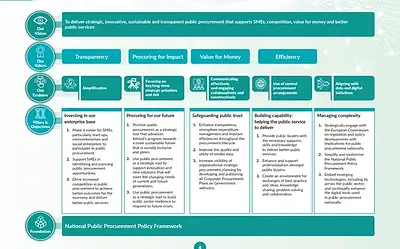
The National Procurement Strategy Is Right About AI — and Silent on the Part That’s Already Here
Ireland’s new National Public Procurement Strategy 2026-2030, published on 5 August, is a serious and largely welcome document. It commits the State to making it easier for SMEs to compete, to publishing corporate procurement plans, and – notably – to improving the quality of the award data that public trust depends on.

Did ChatGPT Make That Number Up? Verifying Facts and Figures in Your Bid
AI invents figures, references and case-study details to fill gaps. How fabricated content sinks tenders, and the verification pass that stops it.

AI Drafting Residue: The Tell-Tale Lines Evaluators Keep Finding in Tenders
In a clarifications register published on eTenders this year, nine consecutive queries from one bidder each open with the literal string “| Lot 1 | Service Category 1 |...

How to Check an AI-Generated Proposal Before You Submit It
The draft is done, the deadline is Friday, and some or most of the text came out of a model. What stands between you and submission is the step most teams compress or...

AI Bid Writing Risks: The Six Ways It Loses You Marks
AI drafting loses tender marks in six specific, fixable ways – from invented figures to brief drift. What we find when AI-assisted bids are scored.

Will AI-Written Bids Be Disqualified? The Rules in Ireland and the UK
No procurement rule in Ireland or the UK disqualifies an AI-written bid. What the rules actually say, what buyers are starting to ask, and what does get you excluded.

AI Bid Tools and Data Security: What to Check Before You Upload
AI bid tools now cover wildly different things with wildly different risk profiles. Find out more.

Proposal Diagnostics: Turn a Bid Review Into a Diagnosis
Proposal diagnostics tell you what’s wrong, exactly where, how much it’s costing you, and what to fix first. That’s the difference between reviewing a proposal and running proposal diagnostics.

AI Bid Scoring: What It Can and Can’t Do for Your Tender
AI bid scoring applies the evaluator’s logic to your finished response. A well-built system reads your bid against the tender’s published criteria and weightings.

Independent Proposal Review: Why a Detached Read Wins More
You can’t read your own bid the way an evaluator will – because you’re informed. The evaluator scores only what’s on the page.

Bid Review Methodology: A Pre-Submission Scoring Pass
Every serious team reviews its bid before submission. Far fewer score it. Learn about the BidReview 5-step scoring pass.

Tender Review Checklist: What to Check Before You Submit
Review your proposal before you submit. This checklist gives you the what: the specific items to verify before you hit submit.
Public Procurement Terminology: A Plain-English Glossary
Public procurement runs on acronyms, and the vocabulary has shifted recently — especially in the UK, where the Procurement Act 2023 renamed a lot of it. This glossary...

Framework Agreements Explained (Open Frameworks & Dynamic Markets)
For many suppliers, frameworks are the single most important route into public sector revenue. A growing share of public spend now flows through them, and a place on the right one can mean years of work.

Competitive Dialogue Explained (and What Changed in the UK)
Competitive dialogue is the procurement route for contracts too complex to specify upfront. Where a buyer knows the outcome it needs but not the solution, it can’t just...

Bid/No-Bid Decisions: A Practical Framework
The most expensive bids are the ones you should never have written. Every tender you pursue consumes time, your best people, and the focus you could have spent on a winnable opportunity.

The Tender Clarification Process: How to Use It Well
The clarification process is one of the most underused tools in public bidding. Used well, it removes the ambiguity that loses marks.

Social Value Scoring Explained (UK PPN 002 & Ireland GPP)
Social value has gone from a tick-box afterthought to a scored, sometimes decisive, part of a public bid. Teams that still treat it as a closing paragraph about “giving back to the community” are leaving marks — occasionally the winning margin — on the table. Here’s how it’s actually scored, on both sides of the Irish Sea, and how to earn the marks rather than gesture at them.

How Evaluators Assess Innovation in Tenders
Innovation is one of the most requested — and most poorly scored — criteria in public bidding. Suppliers reach for the word, sprinkle in “cutting-edge” and...

The MEAT Evaluation Framework Explained (and MEAT vs MAT)
If you bid for public contracts in Ireland or the EU, almost everything you write is marked under one framework: MEAT — the Most Economically Advantageous Tender. Understand what MEAT actually rewards and you understand why some bids win on more than price. Misunderstand it and you’ll keep losing to suppliers who aren’t cheaper, just better positioned against the criteria.

Procurement Scoring Matrix Examples (With Band Descriptors)
The fastest way to understand how your bid will be marked is to see the instrument that marks it. A scoring matrix is no more than a structured way of turning a written answer into a number — but most suppliers never look at one closely, and so they write blind. This article walks through the components and gives worked examples you can hold your own responses up against.

Why Bids Lose Marks (and How to Stop the Leak)
Most bids don’t lose because they’re weak. They lose because they leak marks — a point here, two points there — across answers that everyone on the team thought were fine. The losses are quiet, predictable, and almost always fixable before submission, if you know what to look for.

How Procurement Panels Actually Score Quality Responses
Most suppliers picture tender evaluation as a careful, generous read — an expert sitting with your response, weighing its merits, appreciating the work. That picture is comforting, and it is almost entirely wrong. It leads teams to write for a reader who does not exist, and to be quietly baffled when a strong, compliant bid comes back with a middling score.

Evaluating Social Value in Tenders (Ireland & the UK): How It’s Applied and Scored
Social value in tenders is now a standard component of public sector procurement – but how it counts depends heavily on where you’re bidding. In the UK it’s usually a weighted, scored award criterion worth 10–20% of the quality marks.