
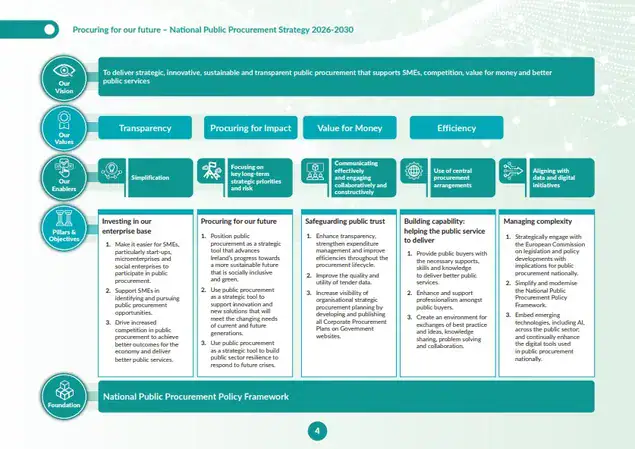
Ireland’s new National Public Procurement Strategy 2026-2030, published on 5 August, is a serious and largely welcome document. It commits the State to making it easier for SMEs to compete, to publishing corporate procurement plans, and - notably - to improving the quality of the award data that public trust depends on. On that last point it is admirably blunt: it accepts that incomplete or inaccurate data risks eroding rather than safeguarding trust. Anyone who has tried to work out who actually wins Irish public contracts will recognise the problem it is naming.
On artificial intelligence, though, the Strategy has a blind spot - and it is precisely in the area moving fastest.
What the Strategy says about AI
The Strategy treats AI, sensibly, as a capability the State should adopt and procure well. Under Pillar 5 it commits to embed emerging technologies, including AI, across the public sector and to enhance the digital tools used in procurement. It positions public procurement as an enabler of the Government’s wider Digital Ireland agenda. And it commits the Office of Government Procurement to examine a central arrangement for buying AI solutions - with the welcome stipulation that any such arrangement should embed transparency, ethics, sustainability and data protection from the outset.
All of that is correct as far as it goes. The State using AI to run itself better, and buying it responsibly, is a reasonable ambition, and the governance instinct - transparency and data protection from the outset - is the right one.
What it does not say
Read the Strategy for what AI is doing to the bidding process itself, and there is almost nothing there. Across a five-year national blueprint, three subjects are effectively absent:
Suppliers using AI to write bids. This is no longer emerging - it is the norm. On current evidence the large majority of tender responses are now drafted with substantial AI assistance. The Strategy, focused on the State’s own use of AI, does not address it.
Buyers using AI to evaluate bids. Not yet common in Ireland - but visibly coming. In November 2025 a Minister confirmed in the Dáil that his department does not currently use AI to evaluate tenders and was still finalising a policy for it. That is the correct position today. It is not a policy for the situation twelve months out.
The strain AI is already putting on the process. The clarification stage is the clearest symptom. It is now common for even straightforward competitions to attract far more clarification questions than they used to, a large share of them AI-generated and adding nothing to the evaluation - yet every one must be answered. Feedback is going the same way: AI-drafted decision letters that grow longer while explaining less. Neither appears in the Strategy.
None of this is a failure of drafting. The Strategy aligns AI to the Digital Ireland agenda, which frames AI as something government adopts. The gap is structural: it treats AI as a tool the State will wield, and overlooks AI as a force already reshaping the competition the State runs.
Why the gap matters
Three reasons, in rising order of seriousness.
First, volume. When every supplier can produce a competent, compliant response in a fraction of the old time and cost, the number of submissions rises and their average distinctiveness falls. Evaluators face more bids that look more alike. A strategy built around simplification that does not plan for AI-driven volume is planning for the wrong decade.
Second, defensibility. This is the real risk, and it is not hypothetical. Elsewhere, procurement bodies have already begun reserving the right to let AI assist evaluation - in at least one live, large-value government tender abroad, on a system that saves no record of what the AI produced, leaving an unsuccessful bidder nothing to test. Closer to the ground, there is a documented case of an evaluation panel running submissions through a general-purpose chatbot, which misattributed content between bidders and nearly produced the wrong award. The danger in every instance is the same: an AI judgement no one can see inside. A public award has to be explainable - to a losing bidder, an auditor, a court. An AI-assisted evaluation that cannot show its reasoning is not efficient; it is a challenge waiting to happen.
Third, timing. The regulatory environment is arriving regardless. The EU AI Act’s transparency obligations are already live, and its stricter duties for higher-risk uses phase in through 2027. Ireland’s own Regulation of Artificial Intelligence Bill establishes a national AI office with real supervisory teeth. A procurement strategy meant to run to 2030 will spend most of its life inside that regime. Saying little about AI in evaluation now simply defers the question to a moment when the law is less forgiving.
What the Strategy could add — without reopening it
The fix is not a new pillar. It is guidance, and the Strategy already commits to modernising the procurement framework and updating buyer guidelines - the natural vehicles. Four additions would close most of the gap:
- Disclosure, handled properly. Ask suppliers to disclose AI use in preparing a response - and, following the approach taken elsewhere, do not score the disclosure itself. The point is to inform proportionate due diligence, not to penalise a tool everyone is using.
- A human-command standard for evaluation. State plainly that where AI assists evaluation, the reasoning and the scores must remain human-authored, inspectable and defensible - with a record of what the AI produced and what the human decided. Not human-in-the-loop as a rubber stamp; human-in-command.
- Feedback and clarification discipline. Recognise the load AI is adding to both, and set an expectation that feedback letters explain the decision rather than bury it - the opposite of the verbose, AI-drafted trend now emerging.
- A supplier-facing word. The Strategy rightly wants more SMEs bidding. It should tell them the truth about AI: it lowers the cost of entering, but a competent AI-drafted proposal is now the floor, not the edge. What wins is fit to the specific requirement, evidenced - the part AI cannot supply from the outside.
The through-line the Strategy already believes in
The most encouraging thing in the Strategy is its own principle on data: that transparency without quality erodes trust, and that reliable data is the basis of public confidence in how decisions are made. That principle is exactly right - and it extends directly to AI in evaluation. An award decided or shaped by a machine whose reasoning cannot be seen is the same failure of trust as an award with no published notice. The Strategy has already articulated the standard. It has simply not yet applied it to the fastest-moving part of its own domain.
Ireland has a genuine chance to be early and sensible here, rather than late and reactive. The Strategy sets the right direction on transparency and on SMEs. Extending its own transparency principle to cover how AI is used - by suppliers to write, and soon by buyers to evaluate - would make it match the market it governs.
BidReview analyses Irish public tenders and audits proposals against the published criteria. We work on both sides of the process - running competitions for buyers and auditing responses for suppliers - which is why the questions in this piece are the ones we see every week.